— Organizational Survival in a World of Disruption

The age
of urgency.

Why do so many organizations feel uncomfortable, pressured and sometimes even anxious when facing the current business and organizational climate?

Because we have entered a new era in which the pace is strong and rapidly increasing.

Technologies are changing and advancing at a dizzying pace, and countless market disruptions amplify one another, generating a large and powerful vortex — the Disruption Vortex.

How can organizations survive — and even flourish — in an age where there is no time to plan, no time to prepare, an age in which everything happens rapidly and urgently?

Read More
Scroll · A World of Disruption
Ram Jaulus · 2018 · 2026 reissue
LIVEThe Disruption Vortex — 7 forces, accelerating NEWEssay · 14.06.26
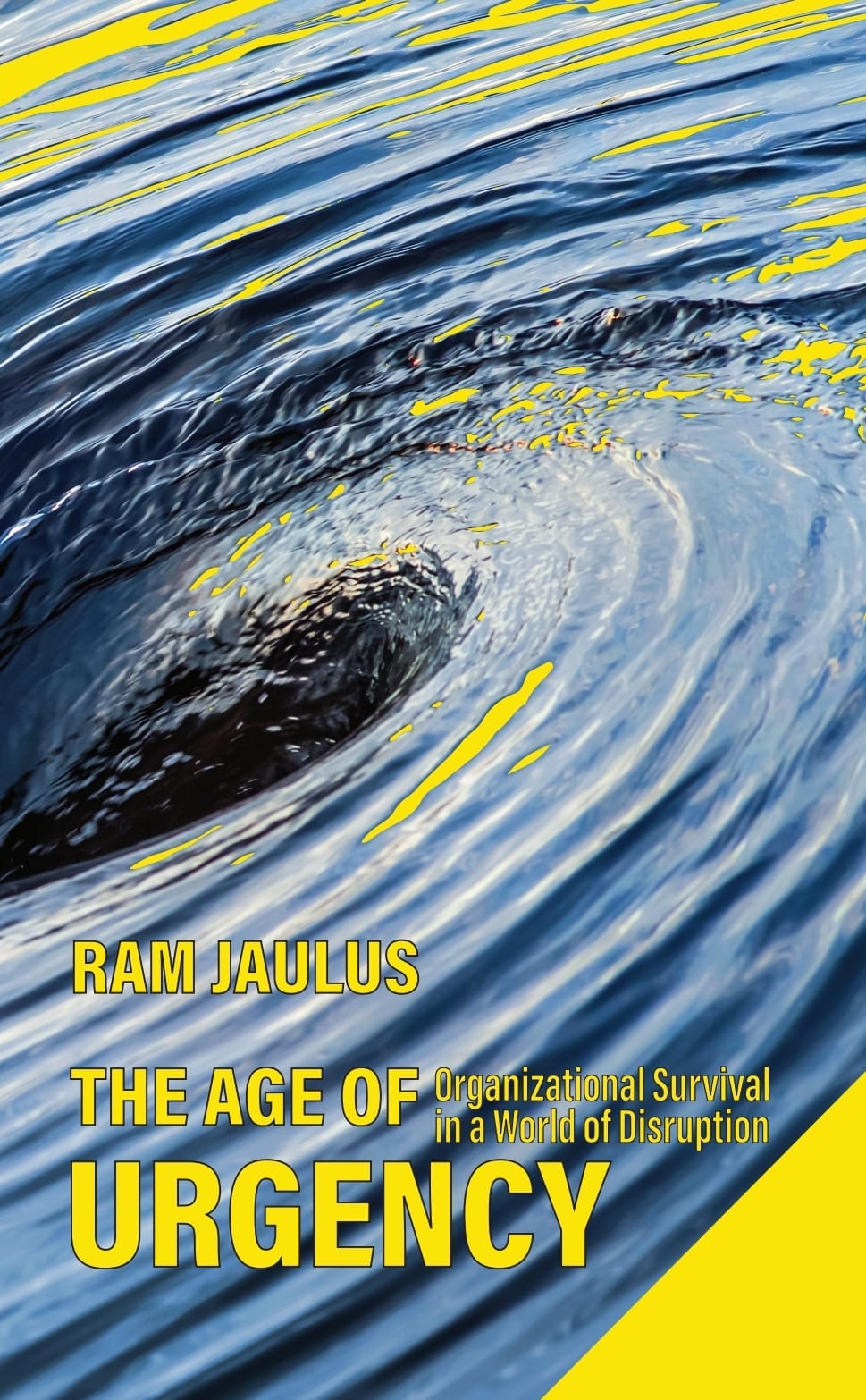
Fig. 01 — Cover
The Age of Urgency — book cover
Ram Jaulus · 2018 / 2026 reissue 2026
§ 01 · Chapter I

A World of Disruption.

/aworldofdisruption

In the past, we believed that a successful change was based upon the foundation of appropriate plans and assessments, and therefore the organization should well prepare before carrying through in a new direction. However, the rules of the game have now dramatically changed. The essence of the change we experience is defined through its pace — and this overturns all earlier assumptions.

The situation is different today than ever before. The pace of change has become one of the key drivers of the changes themselves. Technological innovations completely revolutionize our lives — and do so consistently and frequently. New products and services constantly generate market disruptions. They dispense with previous roles, antiquate existing (successful) technologies, and sometimes eliminate the basis of existence of entire organizations.

Clear and Present Danger.

For any organization, particularly in the business sector, this reality has just one connotation: a giant flashing red light. In a world found in increasing disruption, something must change so that we may continue to exist. Something about us, in the way we manage ourselves, our organizations and our businesses. If we do not take this upon ourselves, no one will.

Charles Darwin recognized many years ago that "it is not the strongest of the species that survives, nor the most intelligent that survives. It is the one that is most adaptable to change." He was right. What is relevant is the adaptation to change, the ability to adjust to a changing environment and to thrive within it in order to achieve success. The solution is to embrace the change.

It is not the strongest of the species that survives, nor the most intelligent — it is the one that is most adaptable to change.

On the one hand — we have "Old World" organizations. They are institutionalized, rigid, with a long-standing hatred for change and a firm belief across all the administrative strata that "if it was not invented here, it has no value". On the other hand — there are the "New World" organizations; the "disruptors", the "innovators". These are the organizations that diligently work on the product they just launched, and to a large extent struggle against the established organizations and the existing agenda.

One thing is common to organizations everywhere, on either side of the continuum: ego and arrogance. We are all busy with the here and now, with what is familiar and comfortable. There is no business supervising "flood control".

It is important to recognize that almost all of today's organizations are addressing the challenge of readiness for the world of tomorrow. Yet this is all just cosmetics; a tactical response. At its core, the organization remains the same, with very limited and delayed response capabilities. To prepare for the future, something very basic must change in the organization. The most basic thing.

↳ Continue · The Day After Strategy
§ 02 · The Day After Strategy

The Day After Strategy.

/thedayafterstrategy

In early 2020, the Corona pandemic — formally known as Covid-19 — invaded our world with no heads-up whatsoever, affecting practically every dimension of our lives. It is considered the first global crisis since World War II and the first to occur in the era of information and communication technologies.

In this global pandemic, powerful events are taking place, labor laws are changing, businesses are collapsing, freedom is being denied and borders are being closed. Our once 'global village' is back to being local, while falling apart into separate components that are drifting farther away from each other. Absolutely nothing has remained the same.

As the ability to be flexible and adapt to a changing reality is essential, change management must become an organic and perpetual component in any organization.

To this list of important organizational components, we should also add humility, mutual guarantee, community contribution, law-abiding and ethical leadership, and of course good decision-making. All of these will be an integral part of the Morning After strategy — the only strategy suitable for our world of disruption and age of urgency.

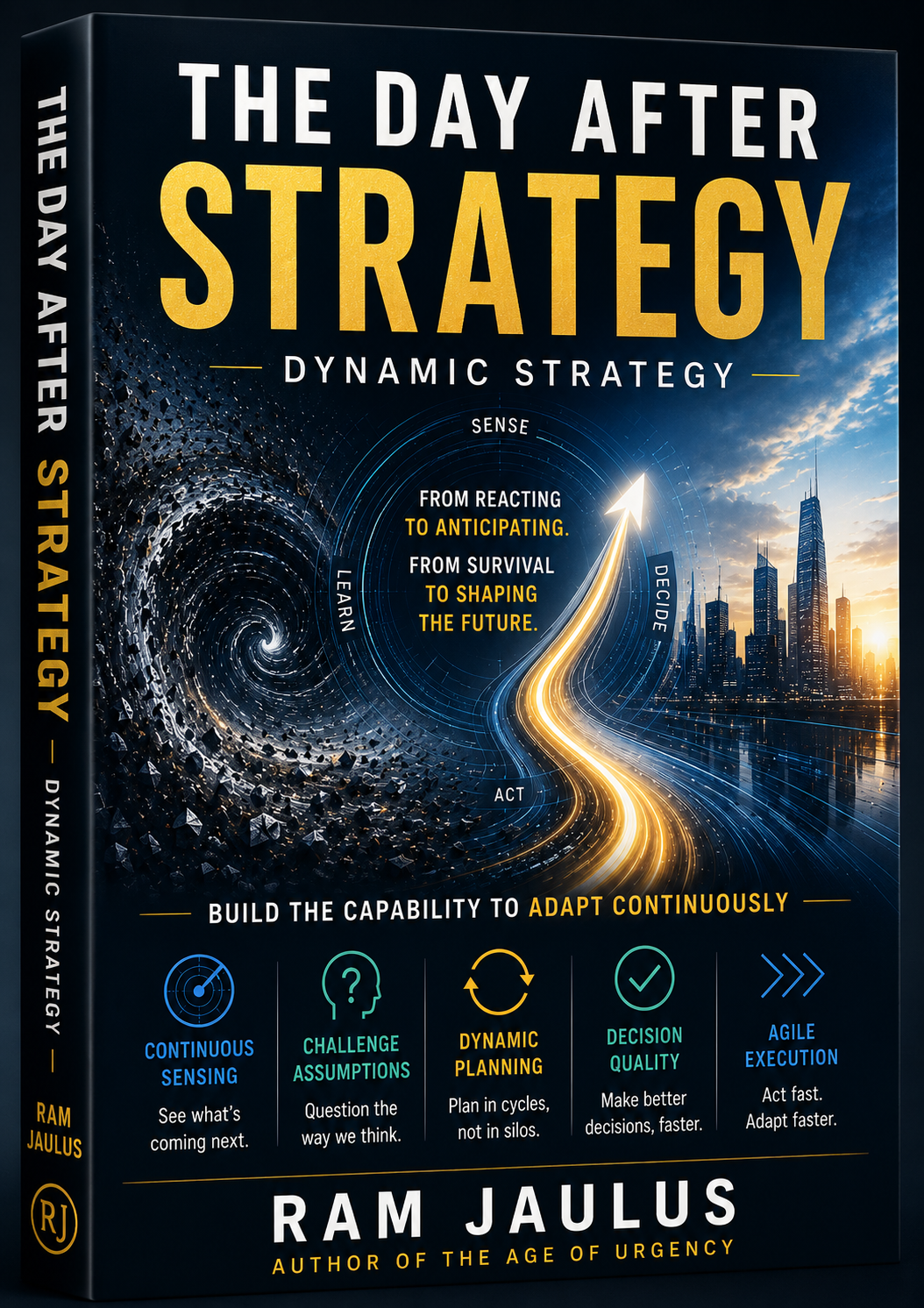
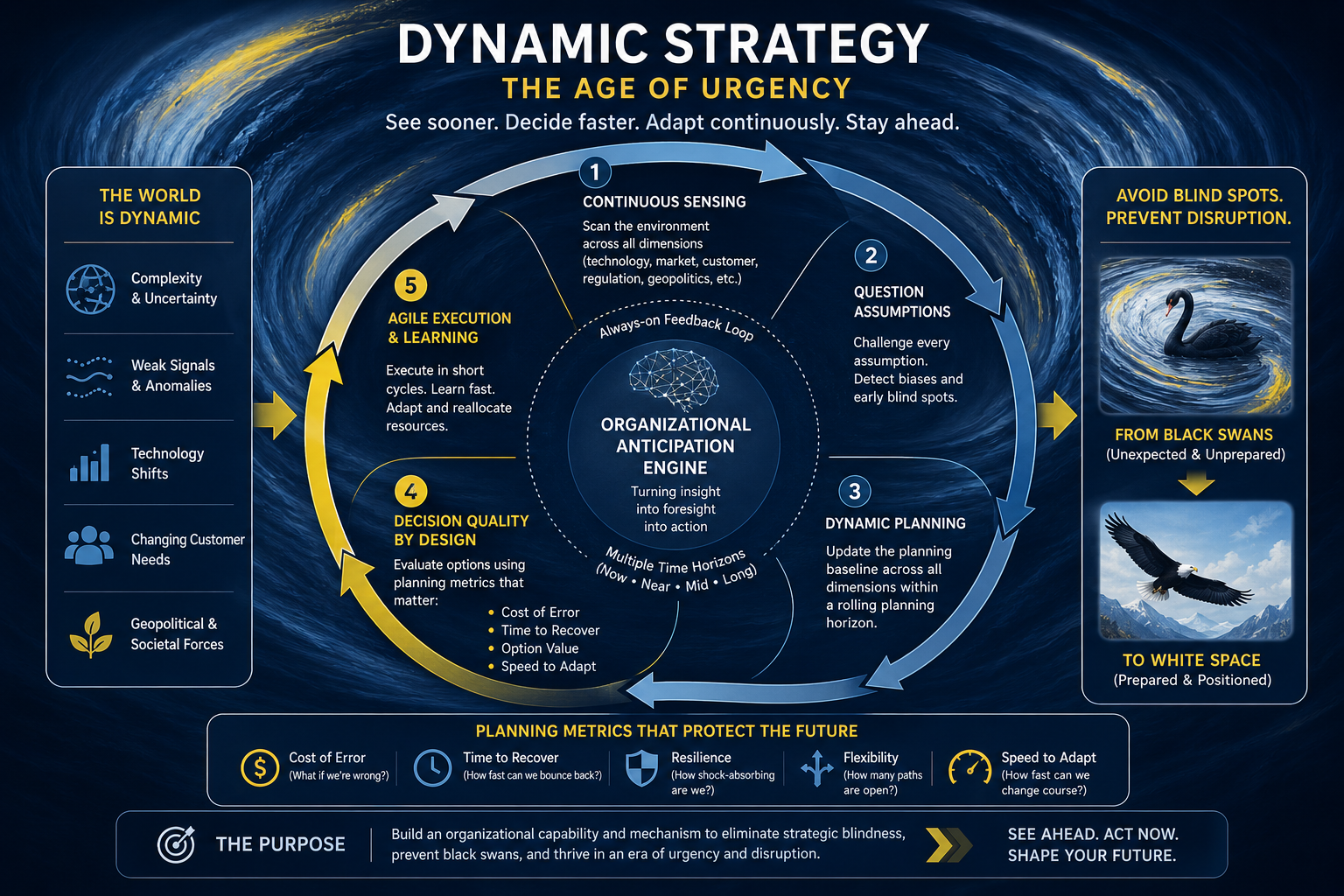
The Day After strategy — Dynamic Strategy is the organizational ability to think, plan and act in a Disrupted world.
Dynamic Strategy — The Age of Urgency. The organizational anticipation engine: continuous sensing, question assumptions, dynamic planning, decision quality by design, agile execution and learning.
Fig. 03 — Dynamic Strategy · The organizational anticipation engine
↳ Read the models
§ 03 · Models & Concepts

Model and Concepts for a world of Disruption.

14 models · upd. 22.05.26
§ 04 · Model · M·01

The 7th Wave.

/the7thwave

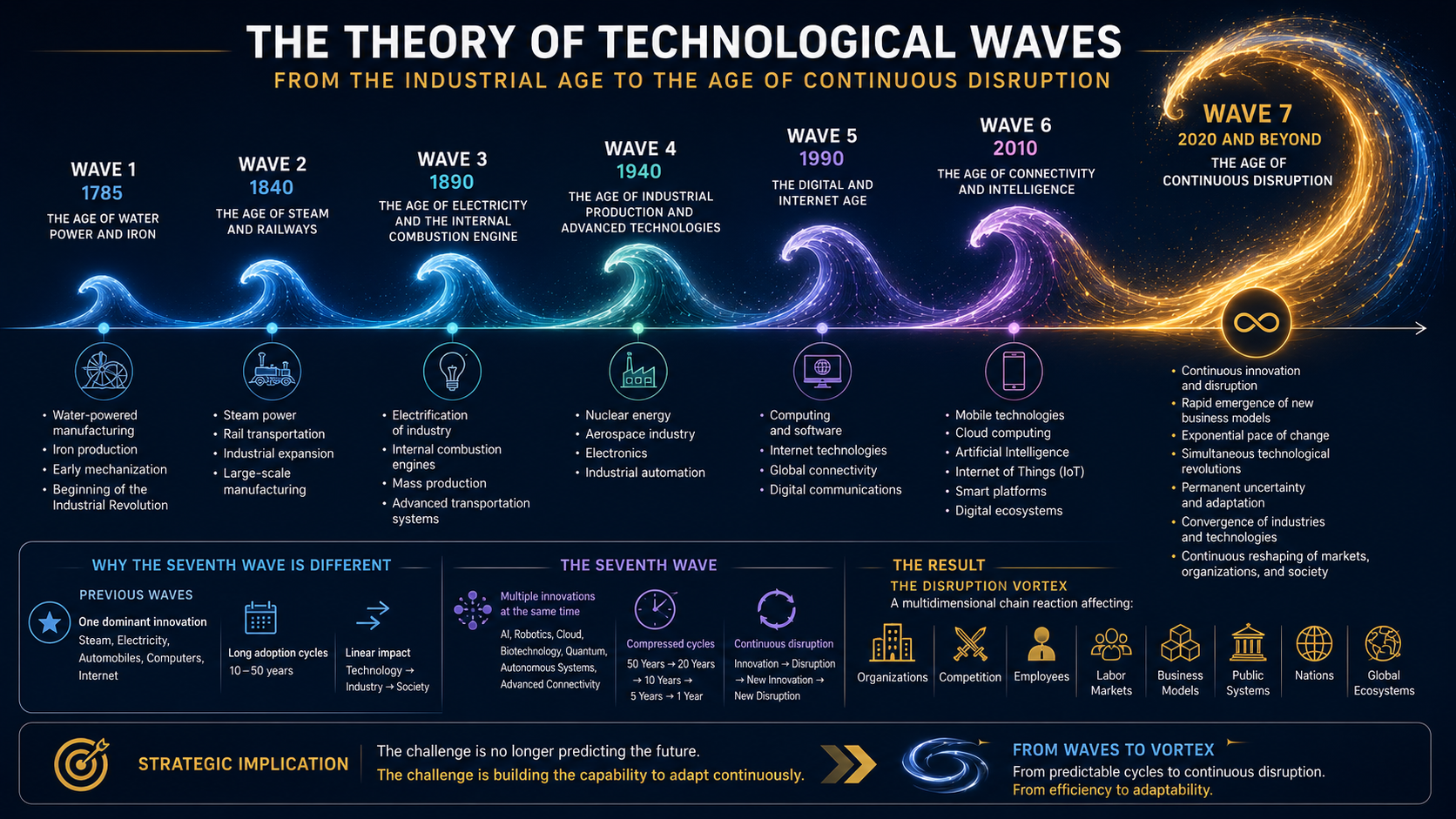
The Sixth Wave. The world of innovation depicts technological development in waves. Most economic theories refer to the wave model and identify six key waves — from the dawn of technological development to the present.

The first wave began in 1785 with the industrial revolution and the use of iron and water power. The following wave was characterized mainly by the steam engine and the railways. The third wave commenced with the invention of electricity and the internal combustion engine at the beginning of the 20th century.

The fourth and fifth waves were more powerful. They occurred during the twentieth century, with the development of the space industry, nuclear power and electronics, followed by digital networks and software.

The sixth wave is currently upon us. It brings about significant changes in communications. It also carries a new aspect: a rapidly increasing pace of change. This pace negates past theories concerning the duration of each innovation cycle. Instead of cycles lasting many decades — we are witnessing cycles which last just a few years, and recently even cycles that culminate within a single year.

The sixth wave exposes us, for the first time in history, to the intensity of disruption. Developments — are global. Physical distance — eliminated. An event taking place in Europe is broadcast live in the United States and generates real-time response. A decision made by the Korean or Chinese government affects the stock markets in England and Australia within seconds. The individual now senses everything in real time. At any given moment we are found in continuous disruption.

The intensity of this disruption is so high, rapid, and system-wide that it delivers an exponential change; one that is rapidly generating the next wave of change.

The Seventh Wave — The Age of Continuous Disruption. The seventh wave is very different from its predecessors. It is not characterized by a major technological breakthrough, but by the pace of change in all areas, a multi-dimensional change. It relates to the amount of innovation that appears simultaneously, and the extent of the continuous disruption that is created.

This disruption is made possible by new technologies that appear at a continuously increasing speed. The internet facilitates the dissemination of knowledge and ideas and enables one innovation to leverage another. We are witnessing the emergence of increasingly innovative technology that affects everyday life, embraced by the public — and is soon disrupted by a new technology and a new model.

The seventh wave breaks down previous organizational models and necessitates the reinvention of models that create agility, reaction speed and an ability to adapt to the changes required today.

The Seventh Wave — the age of continuous, multi-dimensional disruption.
The Theory of Technological Waves — from the industrial age to the age of continuous disruption. Seven waves from 1785 water power and iron through to Wave 7, 2020 and beyond: the age of continuous disruption.
Fig. 04 — Seven Waves · From the industrial revolution to continuous disruption
↳ Next · The Disruption Vortex
§ 05 · Model · M·02

Seven forces, one vortex.

/thedisruptionvortex

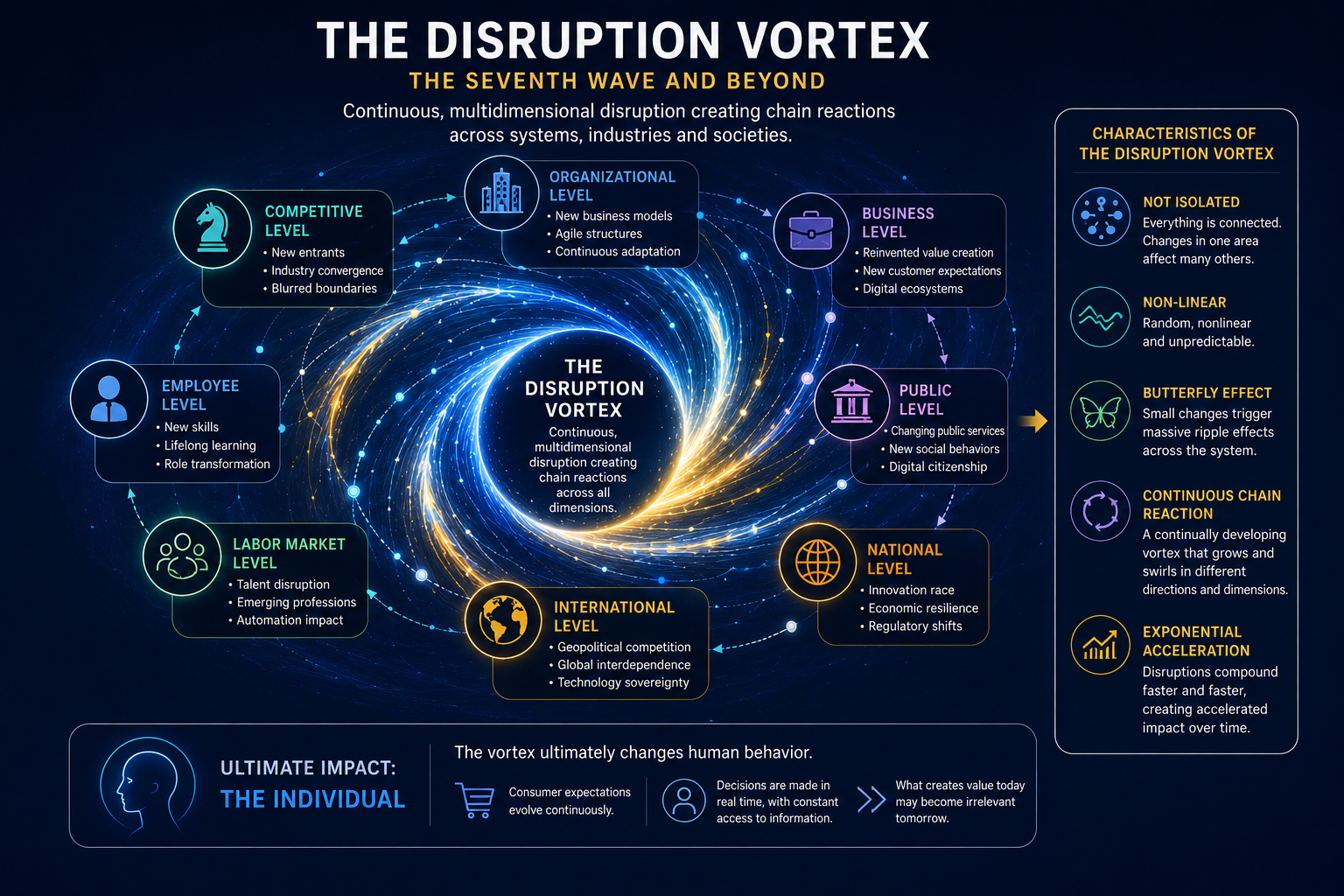
The continuous disruption of the seventh wave has a fascinating multi-dimensional structure. This is a disruption at the organizational level, at the level of competition, at the employee level and in the labor market. This is a business and a public disruption, a disruption at the national and international levels.

These disruptions are not isolated. They are not linear, but rather random and more reminiscent of particles in quantum physics. In practice, all these disruptions develop and create a "Disruption Vortex" — a continually developing chain reaction which grows and swirls in different directions and dimensions. Similarly to the butterfly effect observed in chaos theory.

The disruption vortex affects everything, and predominantly it affects the individual and his behavior. Referring back to the business model, it means that consumer behavior is now fundamentally different than it was before.

A continually developing chain reaction — growing and swirling across every dimension.
The Disruption Vortex — the seventh wave and beyond. Continuous, multidimensional disruption creating chain reactions across organizational, competitive, employee, labor-market, international, national, public and business levels.
Fig. 05 — The Disruption Vortex · Seven forces, one vortex
↳ Next · The Vortex of Needs
§ 06 · Model · M·03

The Vortex of Needs.

/thevortexofneeds

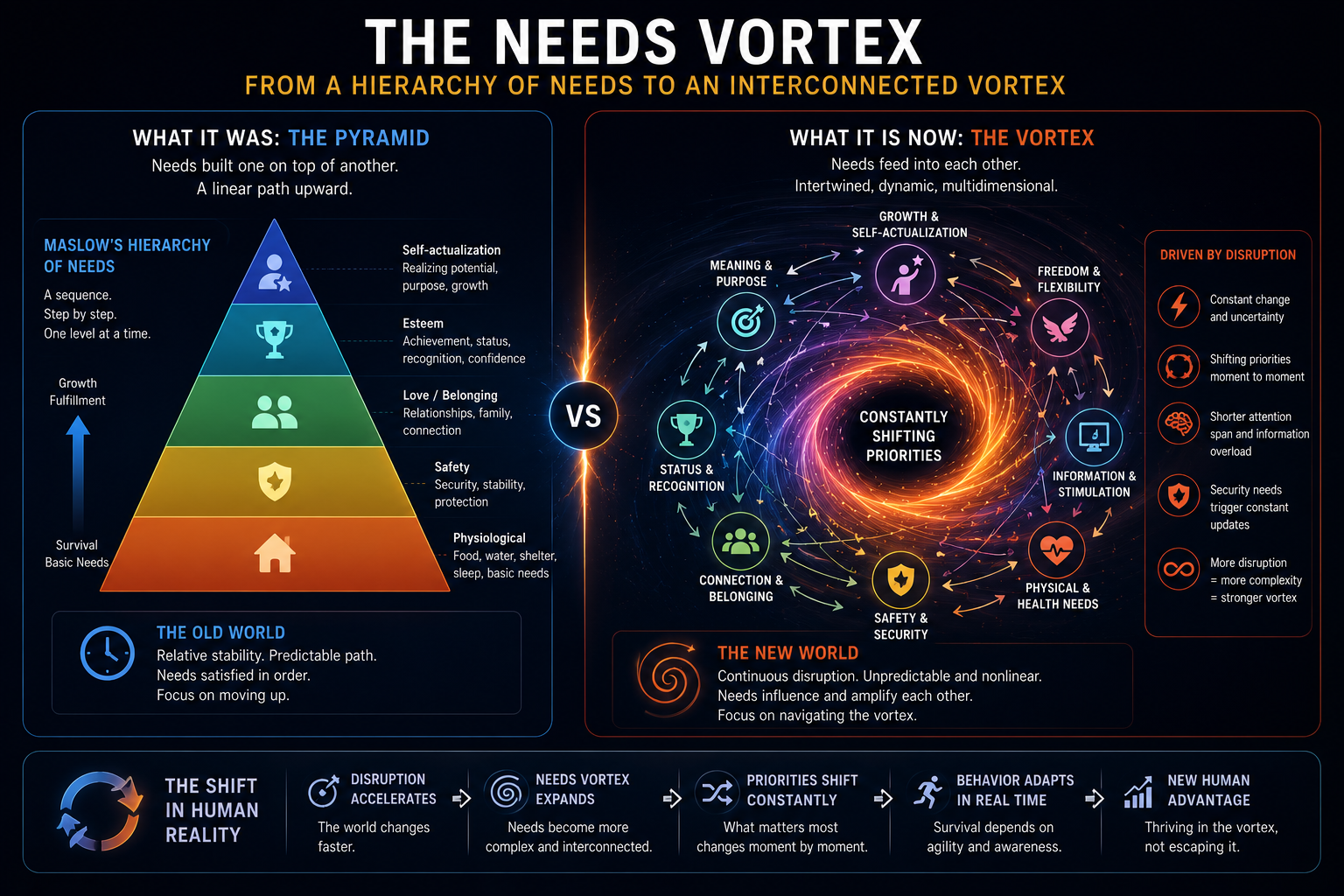
In Maslow's original theory the needs were described as a hierarchy. In the theories which followed, the needs were perceived as coexisting, not necessarily in a hierarchal structure. Today, the different needs feed on each other, interact, interweave and form the structure of a vortex.

This vortex of needs is multidimensional, and within it there exists a strong interaction among the various needs. As the disruption vortex grows — the vortex of needs grows and becomes more complex. Both maintain a synergetic relationship, each sustaining the other.

As the disruption vortex grows — the vortex of needs grows with it.
The Needs Vortex — from a hierarchy of needs to an interconnected vortex. What it was: Maslow's pyramid, a linear path upward. What it is now: an interconnected vortex of constantly shifting priorities, driven by disruption, where needs feed into each other dynamically and multidimensionally.
Fig. 05 — The Needs Vortex · From the pyramid to the vortex
↳ Next · The Reaction Syndrome
§ 07 · Model · M·04

The Reaction Syndrome.

/thereactionsyndrome

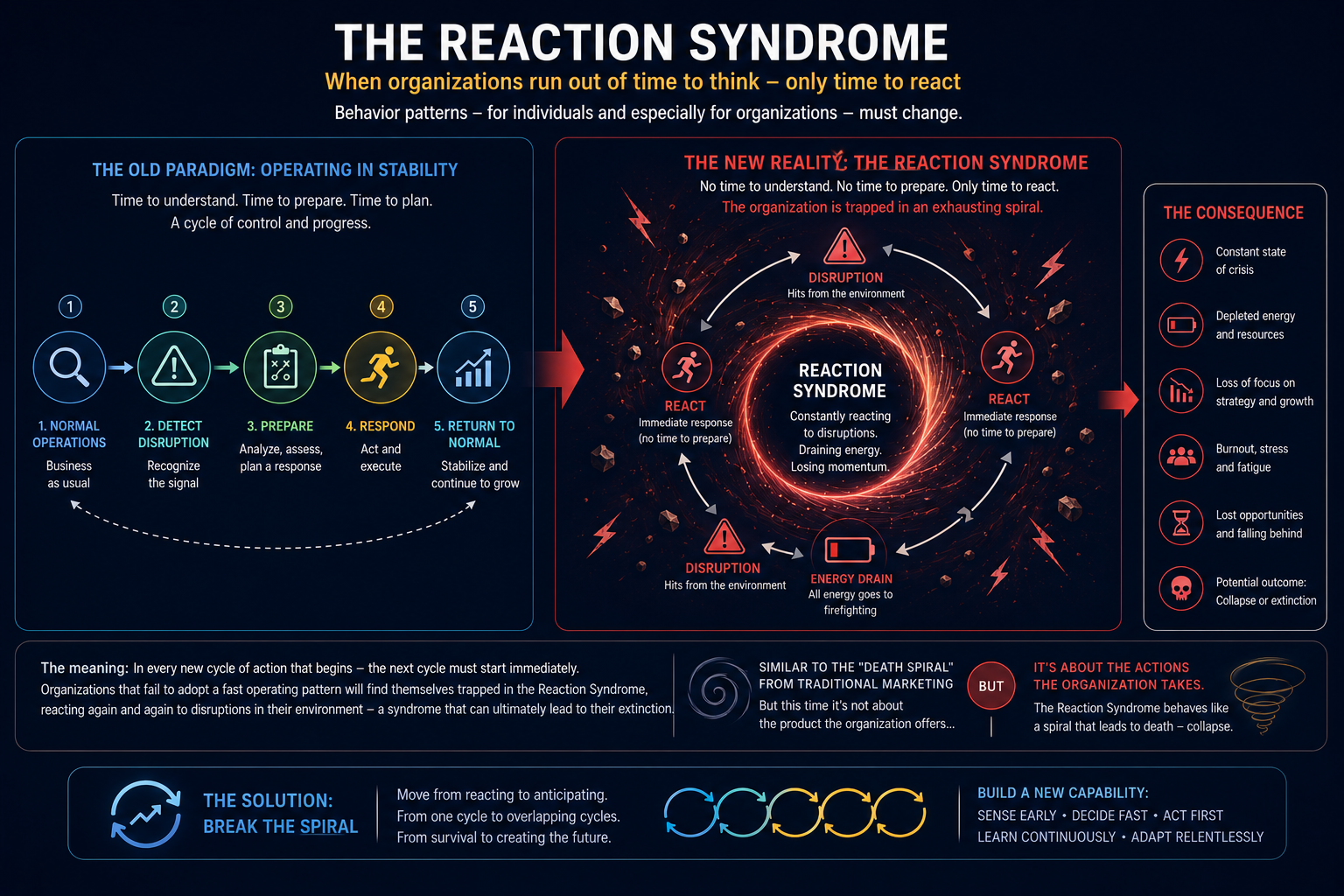
Behavioral patterns in general, and those of organizations in particular, must change. There is no longer time to understand, process, think and plan a response to a phenomenon. There is only time to react.

The implication: for each new cycle that begins, the next cycle of action must immediately follow. Organizations that fail to adopt a rapid pattern of action will find themselves trapped in the Reaction Syndrome — endlessly reacting to disruptions in their environment, a syndrome that can lead to their eventual extinction.

There is no longer time to plan. There is only time to react.
The Reaction Syndrome — when organizations run out of time to think and only have time to react. The old paradigm of operating in stability versus the new reality of an exhausting reaction spiral, its consequences, and the solution: break the spiral.
Fig. 06 — The Reaction Syndrome · From stability to the exhausting spiral
↳ Next · The SOU Revolution
§ 08 · Model · M·05

The SOU Revolution.

/thesourevolution

Sense of Urgency.

Any organization, large or small, new or old, who wishes to survive the disruption vortex and thrive in the world of tomorrow, must fundamentally change. This will not be a cosmetic change, not a departmental reorganization or a sporadic management action. The real key to survival in the New World is the development of new organizational DNA, based on the principles of the SOU — Sense Of Urgency.

What is the SOU?

Overall, it is a sense. An organizational sense. Although it comes from the same word, the connotation here does not imply a "sensation," like panic or smugness, but a sense — like the sense of sight or hearing.

The SOU is the same organizational 7th sense, which identifies the disruption vortex — allowing the organization to seamlessly integrate within it, join its axis, and perhaps create new vortices or operate above them. It is the sense that turns the vortex into the natural habitat of the organization.

A sense — not a sensation. Like the sense of sight, or hearing.
SIGHT HEARING TASTE SMELL TOUCH BALANCE SOU · 7TH ORG FIG. 07 — SENSE OF URGENCY A NEW ORGANISATIONAL DNA
Fig. 07 — Sense of Urgency
↳ Next · The Cyborg Organization
§ 09 · Chapter III

The Cyborg Organization.

/thecyborgorganization

Information technology and Artificial Intelligence have been on an exponential growth curve for several years, reaching a breakthrough point of no return. The ability to influence algorithms and technological advancement across all fields has reached a critical mass of abundance, where one domain impacts the other. Consequently, we are no longer discussing the evolution of a single field, but a multi-disciplinary evolutionary line — The Seventh Wave of technological development.

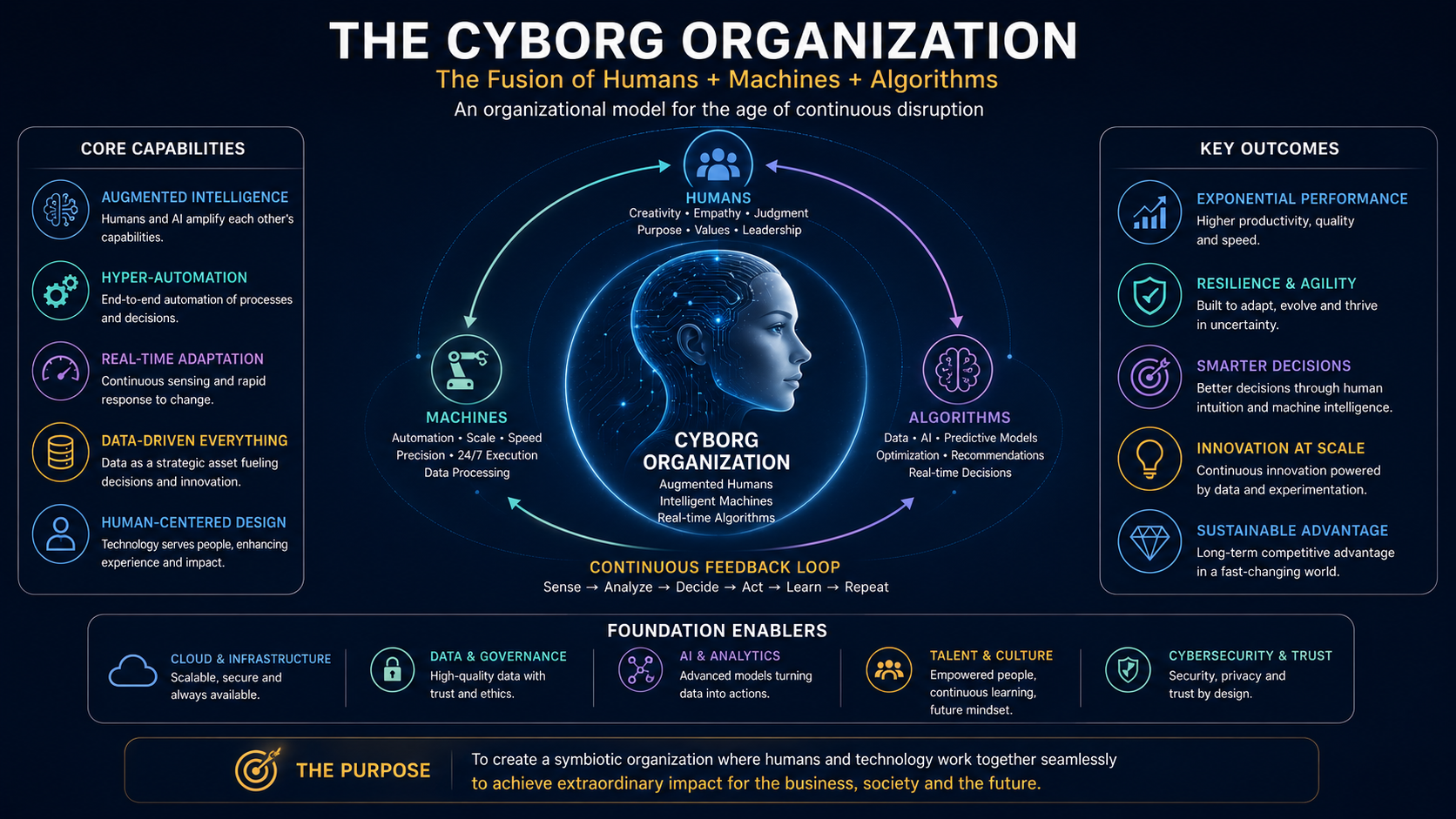
No longer is technology merely supporting processes or being operated by humans; we are entering an era of technology with autonomous capabilities and integrated human-tech collaboration — The Cyborg Organization.

It is now widely understood that the past is no longer a prologue. Companies are convening board meetings and announcing their desire to integrate AI into the organization. Organization-wide training initiatives are teaching the use of common AI tools, and efforts to identify processes and tasks for AI integration have become ubiquitous.

What should the organizational goals be? The threat posed by this evolution is at least as great as the opportunity it brings. The pace of competition, the ability to launch new products, data availability, shifting employee skill sets — everything is changing. Legacy organizations face the challenge of transforming established systems.

A "Legacy" framework is one built on experience, consistency, continuity, pace, and specialization — all of which can act as inhibitors to change. Conversely, new organizations can emerge in an instant, creating disruption in any field.

Established organizations must focus on survival, maintaining functional continuity, and staying competitive.

What needs to be done? Two separate dimensions of thinking must coexist simultaneously:

— The Existing. How do we streamline current operations, accelerate pace, and re-order processes to increase speed and reduce "organizational weight"? This is where the process of identifying areas to empower the organization and its employees through AI integration comes into play. Examples: internal data retrieval, data processing and analysis, replacing human-centric tasks with AI (insurance claim processing and approval, bank loan applications, production line monitoring, cashiers, service representatives).

— The New. A strategic thinking process focused on designing and defining the future organization. This involves examining the implications of technological evolution on the organization's business lines and activities: What is the role of the human, and what is the role of technology? What future functions and processes are required that do not exist today?

Companies and organizations cannot settle for merely improving the "existing." They are required to think outside the box — investing in the fundamental enhancement of current systems while simultaneously reinventing themselves.

Two dimensions, simultaneously: streamline the existing — and reinvent the new.
The Cyborg Organization — the fusion of humans, machines and algorithms. An organizational model for the age of continuous disruption, with core capabilities, key outcomes, foundation enablers and a continuous feedback loop: sense, analyze, decide, act, learn, repeat.
Fig. 08 — Cyborg Organization · Human + AI symbiosis
↳ Continue · Resources
Model · M·06

2nd Generation Disruption.

/2nd-generation-disruption

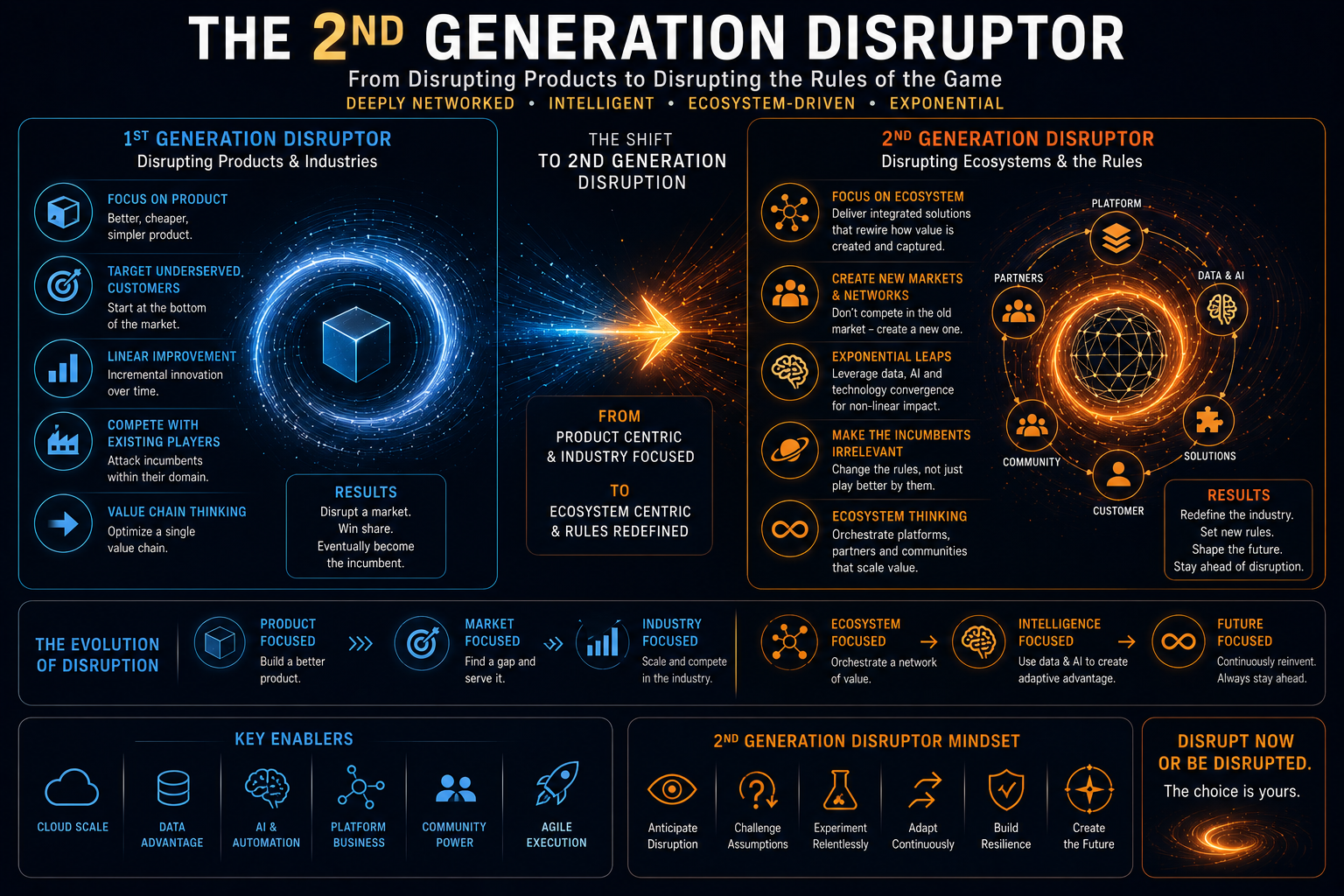
There are currently several very intriguing disruption models reflecting the original intent of the theory, though not fully adhering to it.

  • 01The Small Disruptor.The original definition — a small company with limited resources identifies unfulfilled market segments and uses them as a stepping stone to central segments. The classic example: low-cost carriers entering the airline industry.
  • 02The Parasite Disruptor.Exploits the weakness of an existing model and attaches itself to it, adding a layer of accessibility. Examples: travel-booking and airfare aggregators such as Booking.com or KAYAK, or on-demand transport such as Gett.
  • 03The Eliminating Disruptor.A new technology that displaces and eliminates an incumbent model — replacing a human service provider with technological means. Examples: digital banks displacing brick-and-mortar branches, or traditional postal operations.
  • 04The Disruptor of a Disruptor.Once a company disrupts the rules and dominates, it inherits the traits of a legacy organization — and becomes subject to new threats. A counter-disruption: e.g. a taxi-driver-operated app offering more attractive options as a counterweight to Uber and the like.
Every disruptor eventually becomes the disrupted.
The 2nd Generation Disruptor — from disrupting products to disrupting the rules of the game. 1st generation disruptors focus on product, target underserved customers and improve linearly; 2nd generation disruptors focus on the ecosystem, create new markets and networks, make leaps with data and AI, and redefine the industry's rules.
Fig. 06 — From disrupting products to disrupting the rules
↳ Back to the models
Model · M·07

Organizational Axes.

/organizational-axes

Every organization must develop appropriate mechanisms for survival and success in the disruption vortices. This holds for an organization born into a world of disruption — a digital world — and for a legacy organization adapting itself to such a world.

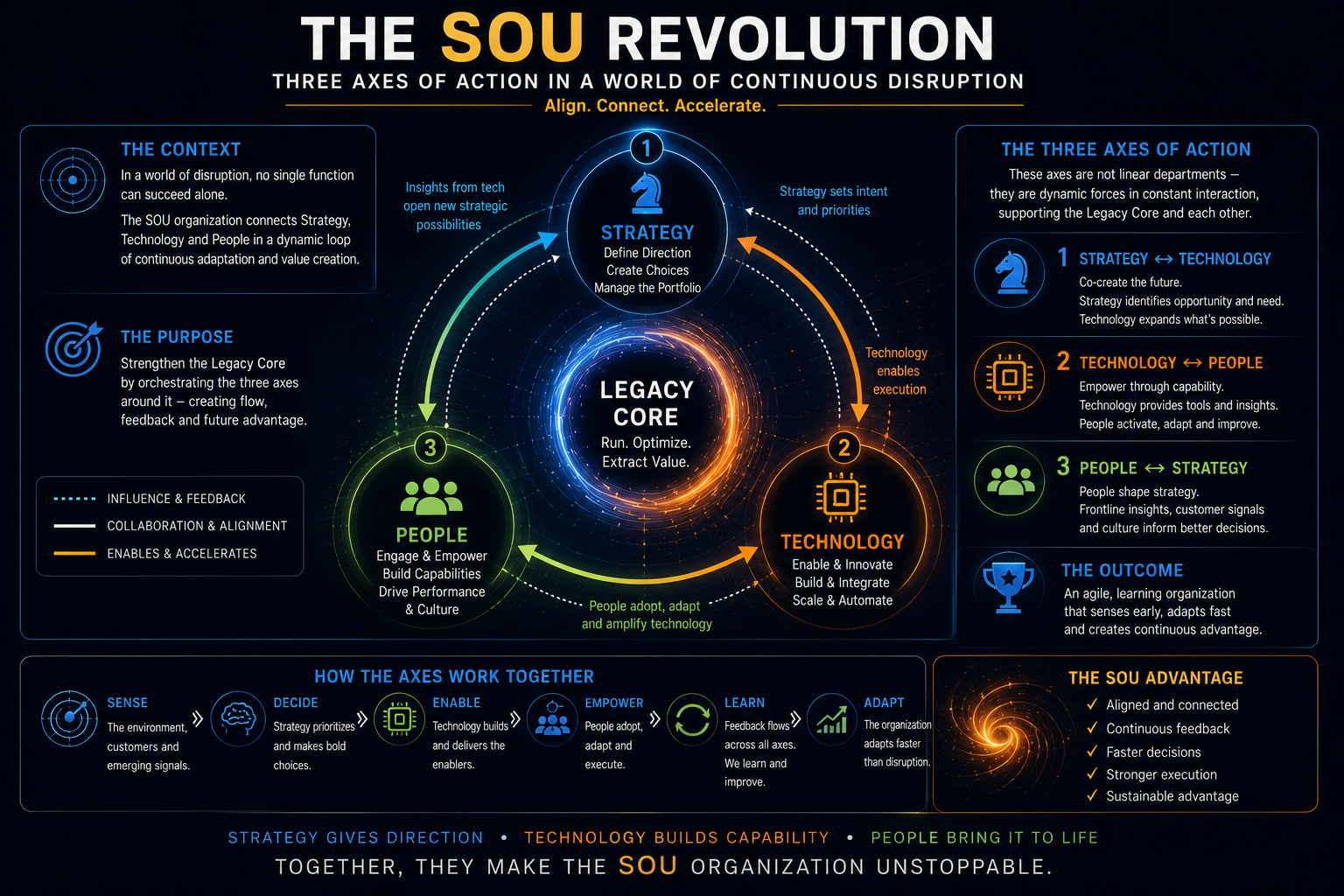
Sometimes the legacy organization, forced to embrace change in order to survive, develops mechanisms superior to those of companies born into this reality, who have never had to weather adversity. These mechanisms are expressed across three central axes that course through the core organization.

Three axes hold the disrupted organization together — strategy, technology, and human capital.
The SOU Revolution — three axes of action in a world of continuous disruption: Strategy, Technology and People orbiting the Legacy Core in a dynamic loop of influence, collaboration and acceleration. Strategy ↔ Technology, Technology ↔ People, People ↔ Strategy, working together through sense, decide, enable, empower, learn and adapt.
Fig. 07 — Three axes of action · Strategy · Technology · People
↳ Back to the models
Model · M·09

The Aging Disruptors Trap.

/aging-disruptors-trap

Organizations that began as a disruption are now gaining momentum and growing rapidly on the basis of a focused business model. But what happens to such a company when a new market disruption occurs? You do not have to be a prophet to see that such a disturbance is sure to come.

All that is required is one energetic entrepreneur whose main concern is not economic gain, but rather a social urge flowing through their blood. They can certainly develop a solution whose sole purpose is to destroy a long-standing model that "annoys" them, for one reason or another.

Yesterday's disruptor is tomorrow's incumbent — and the next target.
↳ Back to the models
Model · M·10

Legacy Organization Conflicts.

/legacy-organization-conflicts

How do you create a new organizational DNA within a long-standing organization? It is not an easy task — it is like walking through a minefield, where each step is liable to tread on an executive's ego or fall into a trap of procedures and logistics. Before we implement the SOU, we must review and understand the conflicts that can delay the process of change.

  • 01The Legacy Role Conflict
  • 02The Self-Service Conflict
  • 03The Information Disclosure Conflict
  • 04The Strategy / Technology Conflict
  • 05The Digital Space Conflict — Who is in Control?
  • 06The Innovation Conflict
Before new DNA can take hold, the organization's hidden conflicts must be named.
↳ Back to the models
Model · M·11

10 Principles for Surviving.

/10-principles-for-surviving

Now that we understand the world toward which we are heading — and the challenges it poses to every type of organization, whether public or private, governmental, military or other — we can begin to outline solutions. First, we must adopt a set of essential principles of action.

  • 01Managing change as routine, and organizational agility.
  • 02Constantly search for new ways to perform tasks — or make them redundant.
  • 03Adopting a technological-strategic mindset.
  • 04Encouraging and developing internal and external innovation capabilities.
  • 05Constant dismantling of functions and roles — a shift toward technology and consolidation.
  • 06Constant search for functions that can be diverted to self-service.
  • 07Disassembling content and information into what can be made accessible and what must be protected.
  • 08Organizational risk management — the cost of errors, and recovery.
  • 09Delegation as a method — not an ideal.
  • 10Detection, development and empowerment of organizational talents.
Survival is not a single act — it is a discipline of constant adaptation.
↳ Back to the models
Model · M·12

Risk of the Polarized Market.

/risk-of-the-polarized-market

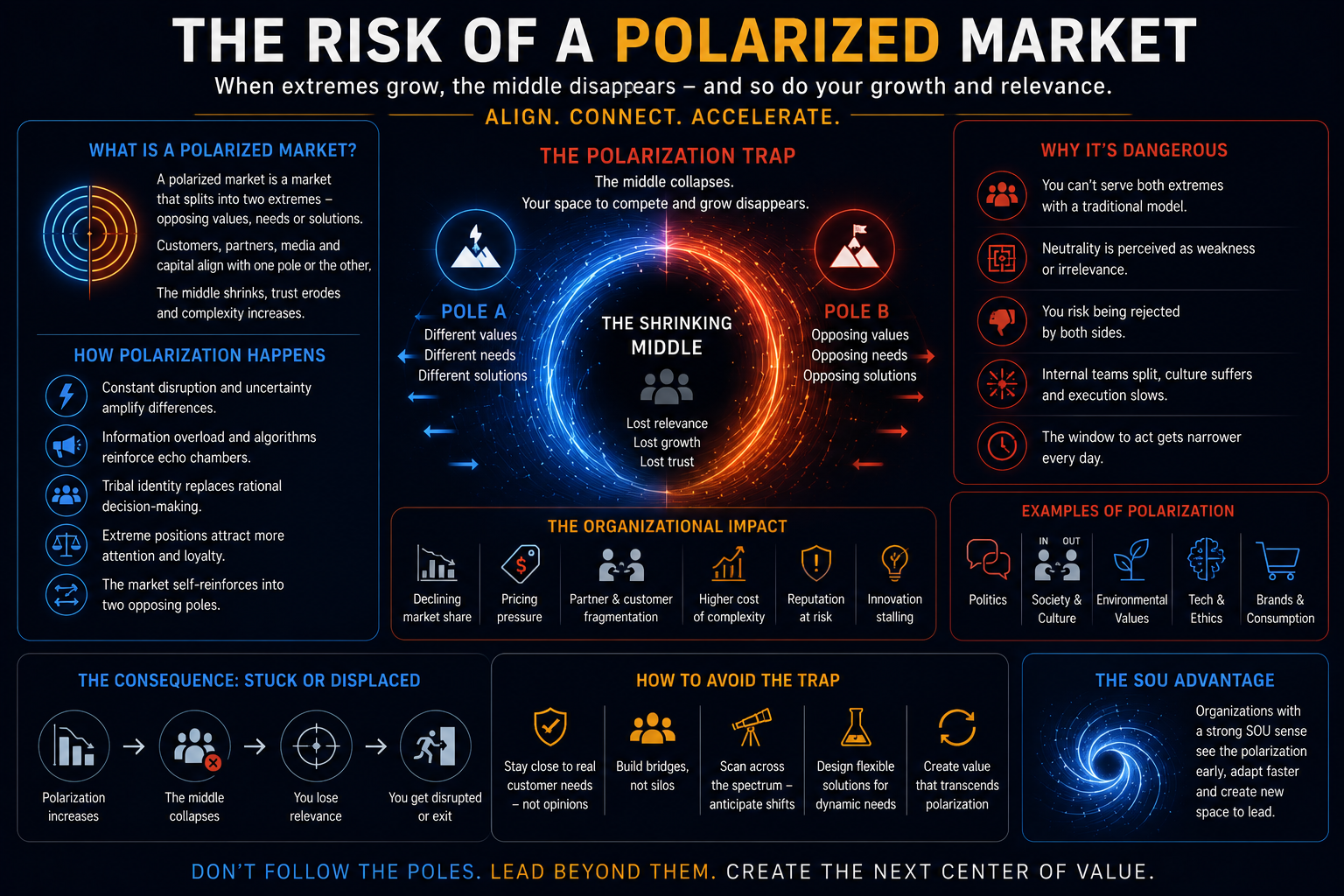
When the degree of disruption in the markets becomes increasingly high, it is very likely that two types of organizations will coexist: giants, and beginning-disruptors. The business dynamics are quite clear. A disruption-creating organization enters the market with a disruptive model, challenges its environment, and then tries to establish itself.

Such an organization is immediately subject to threats from all market elements that have learned to adapt in order to survive. One of two situations will occur: either the new element creates a vortex and draws in older elements, or it is consumed by one of the giants at hand. In this situation, the market becomes polarized — and these two types of organizations coexist.

The disrupted market splits in two: the giants, and the disruptors who would topple them.
The Risk of a Polarized Market — when extremes grow, the middle disappears, and so do your growth and relevance. A market splits into two opposing poles while the shrinking middle loses relevance, growth and trust. Covers how polarization happens, why it's dangerous, its organizational impact, how to avoid the trap, and the SOU advantage of sensing polarization early.
Fig. 12 — The risk of a polarized market · The shrinking middle
↳ Back to the models
Model · M·13

SOU Organizational Models.

/sou-organizational-models

How should the future organizational structure look? How will it be constructed? The very use of the term "organizational structure" raises a question. It was already determined that the essence of the organization must change — and so the term itself is based on the principles of the past.

However, the term does not stem from the belief that this is the appropriate solution, but that it simply is, for now, the solution that works best. Humanity does not yet know how to organize within abstract structures that enable achievement, and so organizational structures have been more successful in achieving goals than other methods.

The future organization — one that has adapted itself to operating in a world of disruption — will strive to act in accordance with the principles of three main dimensions.

A future structure built not on the logic of the past, but on the senses of the present.
  • 01The Strategic Dimension.How the organization defines direction, makes bold choices and manages its portfolio of bets under continuous disruption.
  • 02The Cultural-Behavioral Dimension.The shared senses, habits and reflexes that let people act with urgency — without panic — across the whole organization.
  • 03The Structural Dimension.How roles, functions and information are arranged, dismantled and reassembled so the structure serves the mission rather than the past.
↳ Back to the models
Model · M·14

Leadership Level 5v2.

/leadership-level-5v2

The future of leadership.

It is impossible to consider the organization in the Age of Urgency without discussing leadership. In his book Good to Great, Jim Collins outlines the concept of Level 5 leadership — the characteristics of leaders who took their companies to the heights of success. "Regardless of the company's circumstances," he writes, "its industry or size, Level 5 leaders exhibited common personality traits."

They were devoid of ego, with great humility and absolute willingness to do whatever it took to make their organization thrive. They had a resolute devotion to their mission — always organizational, not personal — while sharing the credit for success and accepting responsibility for mistakes. Their inspiration is carried out not through the personality they radiate, but through the standards they instill.

Yet a market operating in a disruption vortex is fundamentally different from what we have known. Entirely new needs are created — and so different, or at least additional, leadership qualities are required. This is Level 5, version 2.

Humility and will — now joined by the reflexes the vortex demands.
  • 01Dynamism.Moving with the market rather than against it.
  • 02Responsiveness.Sensing and answering signals before they become crises.
  • 03Capacity for Multiple Variables.Holding complexity without freezing.
  • 04Ability to Motivate & Engage.Mobilising people through shared purpose.
  • 05Agile Mindset.Treating change as routine, not exception.
  • 06Ability to Reinvent Oneself.Letting go of yesterday's identity.
  • 07Failure Recovery Capacity.Absorbing setbacks and bouncing forward.
↳ Back to the models
§ 10 · Resources

Reading, essays, and events.

/resources · 9 articles
Essay
5 Ways in Which Omni-Channel Affects Our Lives

From niche oddity to the center of our lives: the omni-channel user experience is coming at us from all directions. Ram Jaulus, NGG CEO, explains.

Read More
Essay
Efficiency, Change, or Extinction — Organizational Transformation in a Technological World

What must organizations do in order to survive in a technologically evolving market? Ram Jaulus recommends seven crucial principles.

Read More
Essay
How Do You Craft a Work Plan in a Chaotic Climate?

In an ever-changing world, is writing a formal work plan really worth it? Ram Jaulus explains how companies benefit from flexibility.

Read More
Essay
Mergers and Acquisitions as a Way of Dealing with Market Threats

Ram Jaulus gives an overview of what CEOs should consider before acquisitions and mergers — parameters and considerations.

Read More
Essay
Education System with ADD

The world is changing rapidly, while the educational system stays behind. The system must adopt new models and processes — as soon as possible.

Read More
Event
Frankfurter Buchmesse 2018

“The Age of Urgency” at the Frankfurter Buchmesse 2018 — the world’s most important fair for the print and digital content business (10–14.10.2018).

Read More
Essay
As the World Moves Forward, Some Jobs Are Left Behind

From customs officers to good old travel agents, traditional jobs are sidelined by technological advancements — a trend that’s here to stay.

Read More
Essay
Organizational Transformation — 7 Principles That Every Organization Must Follow

Seven principles that every organization must follow to make the journey of transformation — in an age where change has become the only constant.

Read More
Essay
What Are the Organizational Conflicts Created by Organizational Transformation?

On the list of factors that influence the inner workings of any organization, technological advancements are definitely at the top. Ram Jaulus reminds.

Read More
Resources · Essay

A Work Plan in a Chaotic Climate.

Ram Jaulus

In an ever-changing world, is writing a formal work plan really worth it? How preliminary planning pays off — and why you should adapt quickly to changes.

Now, more than ever, organizations must contend with an increasingly fast-paced work environment as well as unprecedented levels of uncertainty. Have the old models of planning and thinking become passé? What must organizations consider when approaching the planning process? Which aspects are still relevant, and which ones need to be rethought?

01Planning — horizons, pacing and frequency

Planning horizons have grown drastically shorter. Work plans must be monitored and adjusted continuously throughout the year; organizations must reallocate responsibilities and resources; and methods of oversight and control must also become continuous — it cannot be done after the fact, which is already too late.

It is important to avoid concluding that instability makes planning meaningless. People get carried away with the thought that by the time they complete a plan, everything will have changed. In fact, the opposite is true: everything will change, and that only reinforces the need for short-term, personalized, adaptable plans. Planning increases in depth — and in the frequency by which it must be adjusted. Ask continuously: what needs deeper thought, what can stay modular and be updated as needed, are the traditional targets still relevant, and are the control methods still effective?

02Uncertainty and risk management

There is now a wider range of risks and a higher level of uncertainty, and both make planning harder. Risk management today is an entirely different beast — a mechanism that permeates the entire organization's activities. Each unit must be measured against risk indices, in addition to meeting business and organizational targets.

Characterize and define as many risk factors and uncertainties as you can, and prepare an action plan for issues that may arise — expecting both unpredictable risks and predictable ones that present differently. Build a recovery plan around two primary measures: how long recovery takes, and how much error the organization can absorb financially. Then define the scope of threats the organization can handle simultaneously.

03Flexibility and efficacy — the organizational weight

Everyone talks about "organizational flexibility," but what does the term actually mean? The old indices — cost per unit sold, cost of generating income — are no longer sufficient. Today's organizations need new efficacy benchmarks: an organizational efficacy index that monitors the decline in overall organizational weight over time, and a flexibility index / "cost of change" that measures the cost of a particular change, such as dismantling one unit and establishing another.

04Adapting to change — change management

Change management is an old, familiar concept — but the pace of change is becoming increasingly difficult to manage, and organizations' capacity to deal with it is limited. For preexisting components, adopt and implement an index of change preparedness. On an overall organizational level, examine the human resources' preparedness and the adaptability of the human capital.

The bottom line. The way we plan is changing, horizons are narrowing, and risk and uncertainty are rising. Taking all of these into account, organizations need to adopt new planning methodologies.  Read more in the book →

↳ Back to Resources
Resources · Essay

Mergers & Acquisitions as a Defense.

Ram Jaulus

What should CEOs consider before acquisitions and mergers — parameters and considerations, both old and new — as a way of dealing with market threats.

"Disruption" has become a mainstay in today's lexicon. How do we anticipate the next surprise? How are we going to deal with it? CEOs look to diversify their product portfolios, encourage flexibility, and embrace innovation both internally and externally. One way to cope in this reality is through mergers and acquisitions, combined with other activities.

The familiar reasons

Economies of scale let you deal with change better, reach more segments and strengthen the organization. Diversifying your product portfolio appeals to wider audiences and boosts the chances of survival. Asset acquisition brings a brand, a key audience, sources, representatives, products or technologies the buyer lacks. Access to new markets — whether new products or new geographies — opens through the acquired company.

The new, critical considerations

Decentralizing business lines — buying a competitor with no intention of merging, in order to spread vulnerable risk points across parallel systems. Dividing growth engines into two separate systems, so a line of business that can't take root internally can flourish in the acquired company. And internal disruption — manufacturing competition and internal motivation to challenge the company in new ways. The higher disruption rises, the more such new motivators will appear.

Factors every path must weigh

Synergy — how much is required to balance old and new, and how to ensure the right integration. Cannibalization — how much the companies overlap and might obliterate each other. Reliability — whether the promises behind the acquisition will actually hold. And inclusiveness — the key success factors (KSF) that must occur to manage the organization in its new incarnation.

The key. Organizations examine acquisitions through due-diligence parameters to judge value and feasibility — but CEOs often ignore the organizational, operational and infrastructural components that actually determine success. The key is to examine the internal workings of the organization, not just its bottom lines: do operational due diligence, not merely the financial one.  Read more in the book →

↳ Back to Resources
Resources · Essay

5 Ways Omni-Channel Affects Our Lives.

Ram Jaulus

From niche oddity to the center of our lives: the omni-channel user experience is coming at us from all directions.

In 2017, "omni-channel" became a familiar phrase in every organization and every household. While it had been used sparsely or thoughtlessly in the past, the years that followed ushered in a new era of omni-channel experience — the world rushing to adopt solutions that service users anywhere, anytime.

01It is (nearly) everywhere, always

Omni-channel is present even where we least expect it. Grocery shopping used to be straightforward — place products in a cart, pay, and consumer data is collected, analysed, and turned into personalised coupons sent by mail, online and via app, spanning multiple channels. Companies like Amazon push special offers at the pre-purchase stage, based on browsing and shopping patterns. Medical clinics collect visit data so a patient can renew a prescription in person, on the provider's website, or through an app — with doctors increasingly available online to view files and talk by phone or chat.

02It changes consumption habits

Until recently, all shopping was done in physical stores; we visited the bank and went to the doctor in person. Today much of it is online, banks are scaling back branches, and providers go digital. Amazon's no-checkout grocery store lets customers fill a basket, walk out, and be charged later — appealing to the subconscious wish of leaving without paying. Gaming companies sell physical products mid-play. Everything is becoming more digital, fast, and erratic.

03Everything is connected

There's irony in Nokia's old motto "Connecting People." Today consumers are connected in every way possible — to friends, family, colleagues, networks, deals and email, twenty-four hours a day; the only way to disconnect is to cut the power. Three connections are penetrating the consumer space ever more deeply: IoT (Internet of Things) — appliances that learn usage patterns and are controlled remotely; IoC (Internet of Cars) — connected vehicles that pre-heat, self-park and transmit real-time status; and IoH (Internet of Humans) — wearables that let doctors monitor vital signs.

04It blurs borders

Omni-channel blurs the line between the physical and virtual worlds — a phenomenon set to intensify. In gaming, players start on a phone but interact with real-life elements through augmented reality. Pokémon Go is the prominent example: a game that happens on your phone and in the streets at the same time. Newer, more sophisticated games are constantly in development.

05It raises questions of credibility

If something is said on the internet, does that make it true? Omni-channel created an environment where information is available anywhere, anytime — but availability is not accuracy. The virtual world creates alternative reality and alternative credibility, eschewing reliability in favour of an endless stream of information, without assuming responsibility for its quality or depth.

To summarise. Omni-channel has evolved from an esoteric niche into something every consumer, customer or patient uses daily. Blessing or curse? Only time will tell — but it will be interesting to find out.  Read more in the book →

↳ Back to Resources
Resources · Essay

Efficiency, Change, or Extinction.

Ram Jaulus

What must organizations do in order to survive in a technologically evolving market? Seven crucial principles for organizational transformation.

The rise of technology compels companies to become more efficient, increase performance, and rethink how they operate. There's a tangible fear of becoming obsolete — many still remember IBM, Blockbuster and Kodak, once-successful companies that were tragically late to adapt. The landscape is changing faster than ever, and organizations realise they must adapt with it.

Organizations are affected on three fronts. Technology enables what was once impossible while making entire jobs obsolete — bank tellers, cashiers, travel and insurance agents are vanishing or shifting. Consumption habits are transforming: we watch any movie anywhere, shop online or in fully-engrossing automated stores, and expect smarter experiences delivered immediately. Regulation, late as usual, is trading a holistic approach for immediacy and quickness of response.

Seven principles every organization must follow

1. Change management as a constant. Make organizational agility part of the culture — the time to prepare was yesterday. 2. Always seek better ways to perform tasks, or eliminate them. If something works, it's probably already becoming outdated. 3. Adopt a techno-strategic way of thinking. Merge strategic thinking, business development and business technologies rather than siloing them. 4. Encourage internal and external innovation. The best ideas often come from unexpected places — build a mechanism that channels them.

5. Continuously deconstruct jobs and functions. Reexamine every role for what can shift to technology or specialists, then reconstruct it more economically. 6. Divert functions to self-service. Customers increasingly prefer the freedom to browse, choose and act at their leisure. 7. Sort content and data — public versus privileged. Decide what business knowledge must be protected and what can be exposed to encourage purchases.

Above all — transformation management. Continuously adapting to external change, becoming more efficient and agile, is an existential necessity. Organizations that fail to adapt lower their chances of surviving into the next decade.  Read more in the book →

↳ Back to Resources
Resources · Essay

Education System with ADD.

Ram Jaulus

The world is changing rapidly, while the educational system stays behind. It must adopt new models and processes — as soon as possible — to make this generation listen and learn.

An irrelevant approach

Another school year has ended, yet no one is considering how irrelevant the educational approach is for the next generation. The world is changing rapidly: there is demand for professions that never existed while others become unnecessary, the skills the market needs have changed — and the education system lingers, failing to adapt its content and the way information is made accessible to learners.

A shorter attention span

Consider the length of a learning hour. It was set years ago according to an attention span of 50 minutes; current studies show that span has fallen to as low as 8 minutes. No wonder there's a near-universal diagnosis of attention deficit. The young generation lives in a digital, parallel world — interpersonal communication happens almost entirely through WhatsApp, Instagram and voice messages — yet in the classroom they are expected to stare at a single teacher talking. We cannot change the nature of the generation, only the nature of the conversation with them.

A system losing its effectiveness

Teenagers gather virtually — each at home, on a conference call, playing the same game as a group against others overseas — yet hand in homework as a printed document based on Wikipedia in a clear plastic binder. They research what interests them independently online, much as they consume TV and film: through the internet, without commercials. As the old world loses its power, so does the effectiveness of existing learning systems.

A hybrid model

Students are required by law to sit in classrooms — but if we want them to listen and learn, the system must adopt models, processes and methods drawn from the digital world. The debate is no longer "for or against tablets," but how to adopt a hybrid model combining the physical world with the digital one: lesson plans based on virtual reality, teaching through gaming, and digital communication as a central tool. The digital train is traveling extremely fast — to help the next generation integrate, at least all compartments had better have WiFi.

↳ Back to Resources
Resources · Essay

Organizational Transformation — 7 Principles.

Ram Jaulus

Today the main generator of organizational transformation is technology. Investing in technology itself is not readiness for change — several principles must be adopted.

In today's world, the main precipitant for organizational transformation is technology. It develops far more quickly than any other source of influence over the organization, its impact is felt more intensely, and it demands its own kind of preparation. Yet it is important to realise that investing in technology itself does not mean one is ready for the changes it brings. To be fully prepared, seven principles must be adopted.

  • 01Change management as a constant.Organizational agility, built into the culture.
  • 02Seek better ways — or eliminate tasks.If it works, it's probably already outdated.
  • 03A techno-strategic mindset.Merge strategy, business development and technology.
  • 04Develop internal & external innovation.Channel ideas from everywhere into practice.
  • 05Continuously deconstruct functions.Shift what can be to technology and specialists.
  • 06Divert functions to self-service.Give customers freedom to browse, choose and act.
  • 07Sort content — public vs. privileged.Protect business knowledge; expose what helps.

Above all — transformation management. Continuously adapting, becoming more efficient and agile, is an existential necessity. Organizations that fail to adapt lower their chances of surviving into the next decade.  Read more in the book →

↳ Back to Resources
Resources · Essay

Some Jobs Are Left Behind.

Ram Jaulus

From customs officers to good old travel agents, traditional jobs are sidelined by technological advancements — a trend that's here to stay.

Since the early 20th century, technological advancements have been affecting traditional jobs, forcing them to adapt or making them obsolete. This phenomenon has intensified over the past few years, forcing positions previously taken for granted out of the market.

Disappearing jobs

Customs officers have turned from key figures in the import process into mere administration clerks. Travel agents — remember those? We all prefer to go online to reserve flights, hotels and rental cars. Bank tellers are soon to be extinct, and upcoming developments threaten supermarket cashiers too — self-checkout queues are already common around the world.

Service roles in all sectors have already shifted from face-to-face to phone service. The next stage is scaling back call centers in favour of online self-service. Even public institutions — the Income Tax Authority, the National Insurance Institute, and local authorities — let citizens manage and carry out payments online, saving time and effort.

In the coming decades we can expect even more face-to-face and phone-service jobs to become a thing of the past. There's no doubt: technology is doing away with traditional jobs.  Read more in the book →

↳ Back to Resources
Resources · Essay

The Conflicts of Transformation.

Ram Jaulus

Technological advancement sits at the top of the factors that influence any organization — but companies must take into account the conflicts it creates within them.

In the past, organizations were influenced by new products, changing customer preferences, regulation and competition. Today, the main precipitant of transformation is technology. It affects how customers communicate with the organization, exposes information that used to be privileged, and enables self-service. It develops faster than any other influence — yet investing in technology itself does not mean an organization is ready for the changes it brings.

Conflicts that impede change

  • 01Traditional jobs.Many companies still revere legacy positions and expect employees to be experts in all areas.
  • 02Self-service.A belief that senior employees hold skills that can't be disseminated or handed to customers.
  • 03Exposure of information."Our data is confidential" — fear of letting customers act independently.
  • 04Strategy vs. technology.Which has the upper hand? Technology increasingly governs strategic direction.
  • 05The digital space.Who leads — the business line, or the direct channels driving customers to digital?
  • 06Innovation.Where, and how, the organization makes room for new thinking.

Simply investing in technology without proper adjustments will not create readiness for change — only frustration and wasted resources. Investment must go hand in hand with organization-wide personal and systematic change.  Read more in the book →

↳ Back to Resources
Resources · Event

Frankfurter Buchmesse 2018.

10–14.10.2018

The Age of Urgency at the Frankfurter Buchmesse 2018 — the world's most important fair for the print and digital content business.

The book "The Age of Urgency" was presented at the Frankfurter Buchmesse 2018, held 10–14 October 2018 — the world's largest and most important trade fair for the print and digital content business, bringing together publishers, authors and media professionals from across the globe.

Get the book →

↳ Back to Resources
§ 11 · Testimonials

Voices — on the work.

/testimonials · 13 endorsements

The book 'The Age of Urgency' feels like a book that is both ahead of its time and, at the same time, is very relevant to our day. Ram Jaulus identifies in his book the organizational difficulties facing every manager, analyzes them in an inspiring way, and eventually offers applicable solutions. The book has a place of honor on the crowded bookshelf; I recommend it highly!

Sagit Dotan
CEO, max

As someone who has long worked in the bustling communications market, I am well placed to know the volatility of organizations, consumers, regulation and technologies within the turbulence of disruption. Mr. Jaulus’ book gave me the opportunity to conceptualize phenomena that we all experience and thereby help managers and employees understand our challenges — and deal with them. An excellent book for anyone who wishes to understand where we live and find their own unique path within the vortex.

Senior Executive, Communications

The intensity and the pace of changes in business organizations are not the same as past struggles. This book presents a clear analysis of the causes leading up to this business reality, with an emphasis on the impact of accelerated technological development on organizational processes in different markets. Alongside this clear analysis, Ram Jaulus provides practical tools that managers can adopt in order to adjust their activities to this reality. A fun read!

Alon Mamlok
Head of Online Learning Administration, CET

In an age when the only constant is the change taking place at an accelerating pace, the one who survives will be the one able to adapt to the changes in the best and quickest way. In his book 'The Age of Urgency', Ram Jaulus presents in a simple, purposeful and clear way the main challenge facing organizations and managers in this age, and also provides practical recommendations and tools required for implementation in organizations that want to be here tomorrow.

Senior Manager

Ram Jaulus depicts very clearly the era in which we live today, including the implications for our working lives, our career path, social interactions and personal aspects. It offers an innovative and creative recipe that does not spare any “sacred cows” and helps organizations convert current perils into opportunities that translate into sustainable competitive advantages. This is not just another management book that defines uncertainty or explains how to prepare for organizational change, but rather a unique toolbox, tailored to a world in disruption.

Yossi Ashkenazi
Navy Brigadier General

Ram Jaulus' book, which presents in a clear and organized language the business-organizational experience, and offers practical tools that we can all adopt and assimilate with the professionalism and speed needed in order to adapt to rapid change. Warmly recommended!

Judy Efrimi
VP of Human Resources, Bynet Data Communications Ltd

Ram Jaulus elects to simplify, conceptualize, demonstrate and offer applicable working principles for organizations that strive to function and thrive in a reality where order and chaos are one. Highly recommended!

Adi Geva Ofir
Head of Organizational Development, JDC Israel

An essential book for the toolbox of leaders and executives — recommend.

Daniel Savitz
Senior Executive Coach

Ram Jaulus' “The Age of Urgency” allows for an in-depth and accurate look at the challenges of our time.

Omri Gefen
CEO of Gevim Group

Ram Jaulus manages to bring to our awareness, in a clear and precise way, the reality we are facing today and will face in the foreseeable future.

Pinney Jungman (Brig. Gen., Ret.)
Senior VP of Rafael, head of the Air Defense Systems Division

The book “The Age of Urgency” focuses clearly and fluently on the turbulence of changes faced by management in business organizations.

Yael Greenwald
Deputy CEO, Director of Marketing and Sales, Menorah Mivtachim

The book is supporting us with a practical tool box to use in a world of chaos.

Yoram Neuman
CEO of Emet OEM Solutions

In a world that is changing in a speed of light there is a need to stop, once in a while, look around you, think and restructure your thoughts and insights.

Reader
§ 12 · About

Ram Jaulus.

The Author

Born in 1962, Ram Jaulus is a strategic expert for organizational strategy and transformation, specializing in organizations coping with a world of disruption, and is a world-renowned speaker on the subject.

Ram is the founder and CEO of the international consulting group NGG Global Consulting Solutions (1994) and the software implementation company Xioma Information Solutions (2003). He holds a BSc in Industrial Engineering and Management and an MBA, and served as commander of a naval unit in the Israeli Navy.

Ram lives with his family in Israel, dividing his time between Israel and his work in the United States, Europe, and the Far East.

Born
1962
Education
BSc IE&M · MBA
Practice
NGG Global Consulting — est. 1994
Service
Commander, Israeli Navy unit
Based
Israel · works US / EU / Far East
Contact
rami_j@nggconsult.com
Ram Jaulus
Ram Jaulus NGG / 2026
§ 13 · A World of Disruption

Buy The Book.

/buy-the-book
The Age of Urgency — book cover

Must-Read Book for CEOs.

The ultimate organizational survival guide.

Innovative perspective for the concept of change. How can organizations deal with technologies that change at a dizzying pace? How can they cope with countless market disruptions amplifying one another? The Age of Urgency answers these questions — in a clear, structured, and practical way.

Title
The Age of Urgency
Subtitle
Organizational Survival in a World of Disruption
Author
Ram Jaulus
Editions
English · Hebrew · Digital
English Edition
EN · 01

The Age of Urgency.

The original English edition — print & Kindle.

Hebrew Edition · ‫מהדורה עברית‬
HE · 02

‫עידן הדחיפות.

‫המהדורה המורחבת בעברית — הישרדות ארגונית בעולם של הפרעה.‬

§ Bulk order · Special offer

Need more than 10 books? Contact us for a special offer.

Team copies, organisational rollouts, training programs — we’ll quote you direct.

§ 14 · Contact Us

Get in touch.

/contactus
LinkedIn
Office hours
Sun–Thu · 09:00–18:00 (Israel time)
§ Forthcoming · New Book

The Day After Strategy.

/the-day-after-strategy

Dynamic Strategy — from reacting to anticipating. From survival to shaping the future.

The forthcoming book in the Age of Urgency series. To pre-register interest, request a speaking engagement, or order copies for your organization — get in touch.

The Day After Strategy — Dynamic Strategy. A forthcoming book by Ram Jaulus.
A businessman at the edge of a maze, facing the urban horizon
— The age of urgency

A world found in increasing disruption — where every horizon is uncertain.

Fig. 02 / The view from the maze